
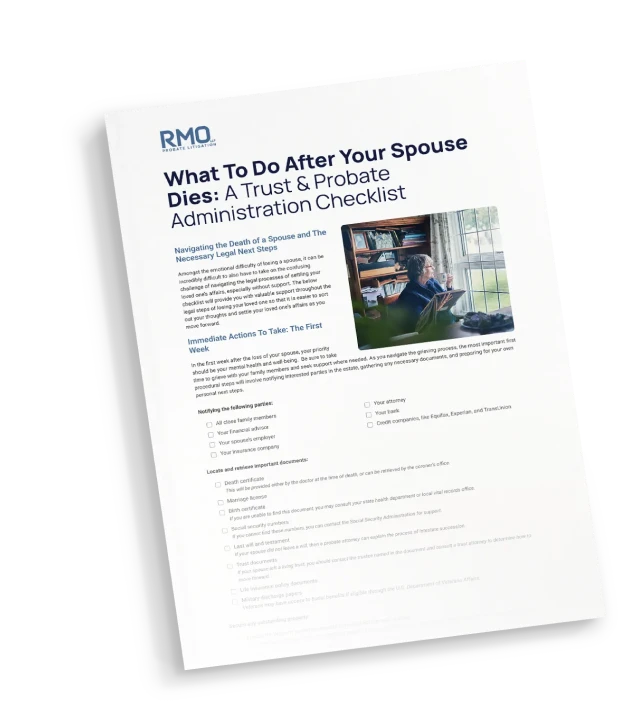
What To Do After Your Spouse Dies
Download Our Checklist to Clarify What Steps To Take When a Spouse Dies
The death of your spouse is obviously a challenging and emotional time. The legal hassle of settling their affairs is the last thing you want to think about during the grieving process. Our detailed checklist guides you through each step, helping to alleviate the stress of navigating the process alone.
This checklist, along with the support of a skilled attorney, can help you avoid the tedious process of trying to understand what steps are necessary when your spouse dies. Download our surviving spouse checklist and then reach out to the attorneys at RMO for support in putting it to use and achieving peace of mind.

What You'll Learn From This Checklist
This checklist helps you understand what steps you should take after your spouse dies, from week one on through the following year and beyond. This checklist lists out important steps so that you can sort out what steps are absolutely necessary after their passing.
You’ll learn the following:
- What immediate steps you should take as a surviving spouse
- What parties you should communicate with and what documentation you should compile
- What your role is in the probate or trust administration process
- The difference between your responsibilities as a spouse and the responsibilities of the estate administrator
- What you can expect from an inheritance as a spouse
All together, our in-depth checklist helps to eliminate guesswork during an already confusing time. You receive a clear road map for the process, allowing you to spend less mental energy and enjoy more peace of mind.
How to Use This Checklist
Follow the checklist in chronological order to understand what steps you should take in the timeline following your spouse’s death. This asset is designed for you to mark off each item as it’s completed, allowing you to clearly visualize what steps remain as your loved one’s estate is settled.
The checklist breaks down the necessary steps into multiple time periods for easy use:
- Week 1
- Weeks 2 to 4
- Months 1 to 6
- Year 1 and onward
The checklist emphasizes the key needs of the process at each of the above checkpoints. As you move through this resource, it’s wise to consult a skilled probate attorney to clarify any steps and support you in executing these responsibilities.
Frequently Asked Questions
What is the first thing you should do when your spouse dies?
The first step you should take after the death of a spouse is to obtain a legal pronouncement of death and then a death certificate. Of course, be sure to prioritize your mental health and well-being throughout this process. Then, when you are able, you should begin notifying relevant parties of your spouse’s death, like the bank, your insurance companies, and your attorney.
Do I need to notify the bank when my spouse dies?
Yes, you need to notify the bank when your spouse dies. You should provide the bank with an official copy of the death certificate. The bank will then either transfer the account to you, if you had rights of survivorship, or close the account for the funds to be distributed during probate. You should also notify any other financial institutions, such as credit companies, lenders, and investment brokers.
When a spouse dies, does everything automatically go to the surviving spouse?
Not everything automatically goes to the surviving spouse. The surviving spouse will inherit any assets that they owned jointly, of which they were a named beneficiary, or that were classified as community property.
However, other property, like separate property, may need to pass through probate to be distributed to the appropriate heirs according to state law, if applicable. For example, a share of the deceased’s assets will also likely go partially to the spouse and partially to their surviving children if they had children. A probate attorney can help you understand what property you may be entitled to as a surviving spouse.
What do I do if my spouse dies without a will?
If your spouse dies without a will, then the estate will likely need to pass through a process called intestate succession. In this process, assets from the estate will be distributed according to state intestacy laws, which dictate a line of succession for who should receive an inheritance. It’s advisable to consult an attorney to understand next steps for petitioning to open probate if your spouse did not leave a will.
What am I entitled to if my spouse dies?
What you are entitled to as a surviving spouse depends significantly on state laws and which heirs survive the deceased spouse. If you are in a community property state, you are entitled to 100% of the community property that was shared by you and your spouse, no matter what.
If your spouse had children, the children are entitled to a share of the separate property. For example, with one child, the spouse has a right to 50% of the separate property, with the child having a right to the remaining 50%. However, these distributions can change if the decedent left a will explaining alternate instructions for how to distribute assets.
Do I need an attorney after a spouse dies?
After your spouse dies, it is advisable to consult a probate or trust attorney who can offer several layers of support throughout the probate or trust administration process. An attorney can provide support with important steps like understanding which assets must pass through probate, filing for probate with the court, and navigating the legal steps to administer the estate.
It’s also possible that the process can become contentious if there are disputes between heirs and beneficiaries. An attorney can help address these disputes and seek a resolution sooner rather than later.
Free Consultation
A member of the RMO Client Relations team will reach out to gather additional information concerning the parties to your case and schedule your consultation.
Communication Disclaimer
Please note that communications by you to RMO LLP or any of its lawyers through this website do not create an attorney-client relationship between you and the firm. Do not send any privileged or confidential information to the firm through this website or otherwise until instructed in writing from us to do so.