
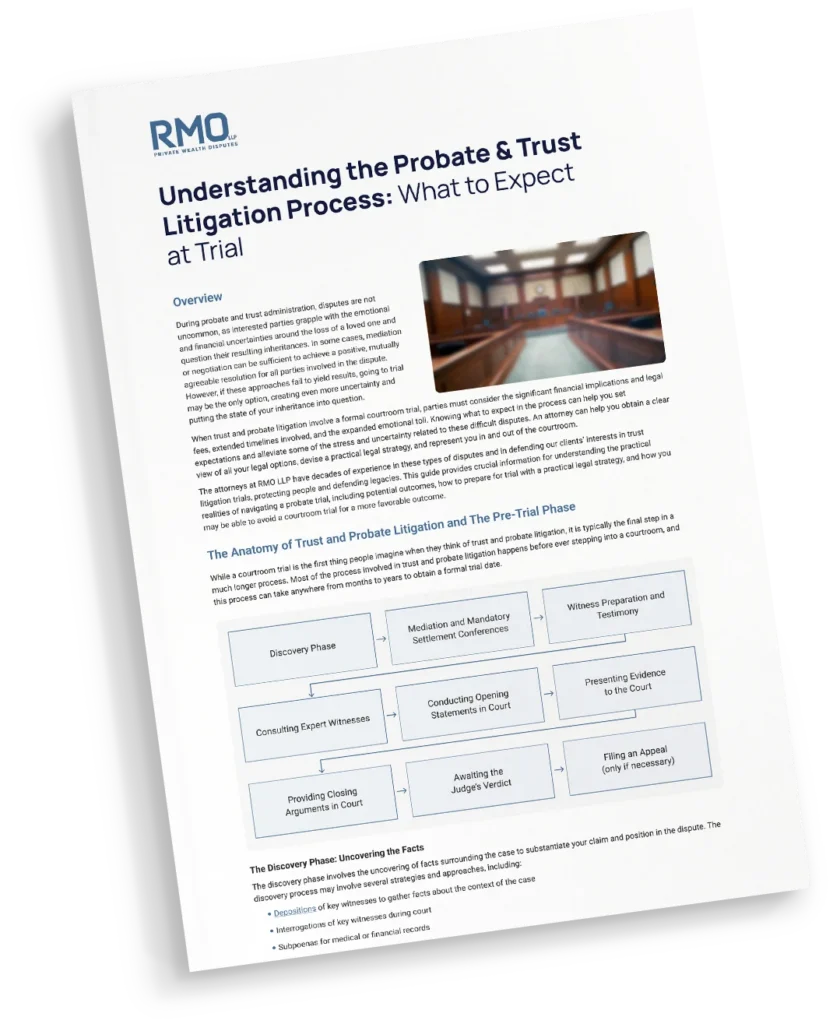
Understanding the Probate & Trust Litigation Process: What to Expect at Trial
Download Our Free Guide to Discover What to Expect at Trial During Probate & Trust Litigation
Probate and trust litigation is a difficult situation that is not only emotionally taxing but also places your financial future at risk. These cases may be resolved by mediation before ever entering a courtroom trial, or they may need to end in court after presenting evidence to a judge who will make a decision based on the facts of the case. In any circumstance, the process of resolving a dispute can be intimidating and overwhelming, especially when going to trial. This guide is designed to provide you with more confidence and clarity.
Whether you are a trustee, executor, beneficiary, heir, spouse, or other interested party, this guide can be a valuable resource for supporting you in navigating your legal matter. If you are facing probate or trust litigation, the experienced litigation attorneys at RMO LLP, in combination with this guide, can help you navigate the challenges of assessing the strength of your case, gathering evidence, and presenting your case while advocating relentlessly for your interests in mediation or litigation.

What You'll Learn From This Guide
Our guide will provide you with foundational information about the trust and probate trial process and what steps are involved. If you or your family are facing trust or probate litigation, this guide can provide you with more information about the road ahead to set expectations for the steps you will need to take and what you should anticipate from the process.
In this guide, you will learn more about:
- The timeline of the probate litigation process, from the pre-trial discovery process to the judge’s final verdict
- What exactly happens inside a courtroom during a bench trial, including evidence presentation and closing arguments
- How to prepare for the emotional and strategic realities of witness testimony and cross-examination
- What to expect after the trial concludes, including statements of decision, potential remedies, and the appeals process

How To Use This Guide
Read this guide to familiarize yourself with the procedural mechanics and potential timelines associated with probate and trust litigation for trustees, executors, beneficiaries, heirs, and other interested parties facing an impending probate or trust trial. This guide is designed to provide you with a foundational knowledge of courtroom procedures so you know what to expect during litigation.
Using the insights you gather in this guide, you should turn to a specialized probate litigation law firm to support you in your case. While this guide provides you with an initial insight into the process, an experienced contested probate lawyer, like those at RMO LLP, will help you develop a more comprehensive legal strategy, conduct a specific case analysis, and represent you in a high-stakes estate dispute trial.
Frequently Asked Questions
How long does a typical probate or trust trial last?
A typical probate or trust trial in the courtroom may range anywhere from one to two days for a simple dispute to a month or more for particularly complex estates with a significant number of assets. However, the process itself can last anywhere from a few months to several years, depending on the complexity of the case, the size of the estate, and the nature of the claim.
If a dispute can be addressed through negotiation or mediation, the timeline is often shorter, sometimes significantly shorter, depending on the involved parties’ ability to schedule a mediation hearing and reach an agreement. However, when litigation is necessary, the processes involved between filing a petition, awaiting your court date, and presenting your case over several days are far more time-consuming.
Do I have to testify in court if I am a beneficiary?
Whether you have to testify in court depends on the nature of the case and the circumstances involved. For example, if you are a beneficiary who was a witness to a family member unduly influencing a vulnerable creator of a will, or you are a party contesting a trust, you may be subpoenaed to testify on your experience.
In any case, offering your testimony in court is valuable for providing the judge with as much context and information as possible for making a fair and reasonable ruling. You should always discuss your unique circumstances with an attorney and the potential implications of testifying.
What is the difference between a bench trial and a jury trial in probate?
In probate, a bench trial is a case in which a judge hears the evidence presented by both sides and acts as the trier of fact, providing their decision on a final ruling for the case, while a jury trial is a case in which a jury acts as the trier of fact and provides a final ruling based on the evidence presented.
The vast majority of probate trials are handled via a bench trial. While uncommon, a jury trial may be requested in some cases where the decedent may have been taken advantage of through fraud or undue influence. Still, a jury trial is not automatically granted—it must be formally requested and approved by the court.
Can a probate trial be settled before the judge makes a final ruling?
Yes, a probate trial can be settled before the judge makes a final ruling, as interested parties can attempt to reenter mediation or negotiation at any point in the probate court timeline. If parties come to a mutually agreeable resolution outside of court before the trial is complete, then it will no longer be necessary to wait for the judge’s ruling.
Who pays the attorney’s fees in a trust litigation trial?
In a trust litigation trial, each party is responsible for paying their own attorney’s fees. The exception is that trustees may use trust funds to defend the interests of the trust.
The petitioning party is responsible for paying their own attorney’s fees. However, in cases of misconduct or breach of fiduciary duty, the court may ultimately order the party who acted with wrongdoing to cover the other party’s attorneys’ fees. Still, they generally must pay their own attorneys’ fees upfront and may receive compensation only after the trial ends, if the judge orders it.
Similarly, in cases where a trustee acts negligently against the best interests of the trust, they may be ordered to repay any funds used during the trial to defend their case back to the trust.
What happens if the losing party refuses to follow the judge’s order?
If the losing party refuses to follow the judge’s order, then the aggrieved party may file a motion for contempt or enforcement. This may result in additional fines, payment of the other side’s legal fees, or more severe legal penalties, such as jail time.
If you are an interested party in a trust or probate dispute and a party is failing to follow through on the judge’s order, you should contact your attorney as soon as possible to support you in filing the necessary court motions and protect your family’s interests.
Can a judge remove a trustee during the trial?
A judge can order the removal of a trustee during a courtroom trial if they have found that the trustee has engaged in misconduct that demonstrates a failure to act in the best interests of the trust. Typically, a trustee is removed during a final judgment after closing statements have been made and the judge has provided a final verdict on next steps.
However, in cases of gross misconduct, such as asset theft, a judge may issue an emergency judgment to remove the trustee to protect the interests of the trust and appoint a temporary trustee in their place.
Free Consultation
A member of the RMO Client Relations team will reach out to gather additional information concerning the parties to your case and schedule your consultation.
Communication Disclaimer
Please note that communications by you to RMO LLP or any of its lawyers through this website do not create an attorney-client relationship between you and the firm. Do not send any privileged or confidential information to the firm through this website or otherwise until instructed in writing from us to do so.