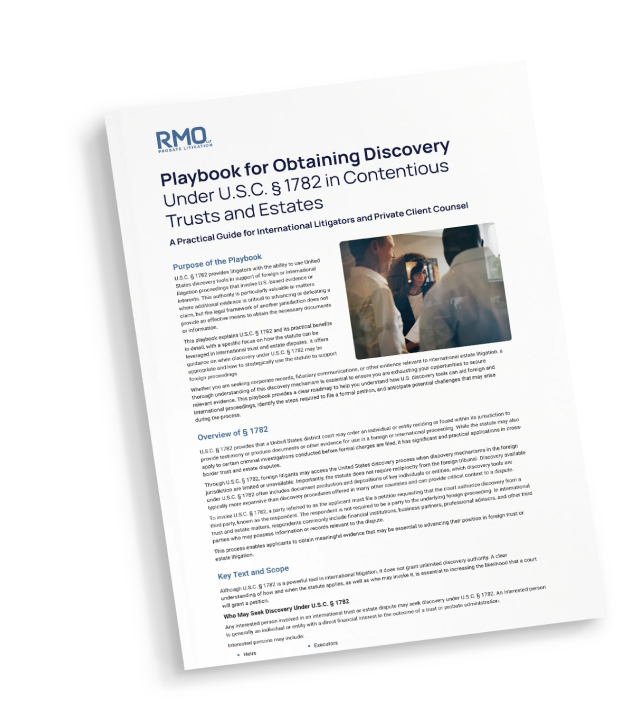
Playbook for Obtaining Discovery Under U.S.C. § 1782 in Contentious Trusts and Estates
Download Our FREE Playbook for Obtaining Discovery Under U.S.C. § 1782
Trust and estate disputes are inherently complex. International contentious trusts and estates add another layer of difficulty by requiring parties to navigate multiple legal systems and obtain evidence located across different jurisdictions. Gathering that evidence can be time-consuming and uncertain without a clear strategy.
Our playbook explains how United States Code § 1782 can be used to obtain discovery in the United States for use in international contentious trusts and estates cases. It provides practical guidance on when discovery under U.S.C. § 1782 is available, how the process works, and the steps required to request evidence effectively.
Download this playbook to understand what to expect and how to prepare when seeking discovery under U.S.C. § 1782.

What You'll Learn From This Guide
This guide is designed for parties involved in contested trust and estate matters, as well as their counsel, who need a clear and practical overview of international discovery under U.S.C. § 1782.
The resource explains both the legal framework and the procedural steps involved, so you can evaluate whether discovery under U.S.C. § 1782 may help you obtain the evidence you need to move your matter forward.
In this guide, you will learn:
- What U.S.C. § 1782 is and why it is important in international disputes
- What kind of discovery is available under U.S.C. § 1782 and when it may be beneficial
- How U.S.C. § 1782 applies to cross-border contentious trusts and estates
- The steps required to seek discovery in international matters under U.S.C. § 1782
- Common challenges and potential pitfalls when pursuing discovery, and how to address them
This playbook is intended to help you approach international discovery with greater clarity, preparation, and confidence.

How To Use This Guide
This guide provides a clear, concise overview of the complexities involved in seeking U.S. discovery for foreign disputes. For parties involved in international trust or estate disputes, the playbook offers practical guidance on navigating the process of petitioning a court for foreign discovery.
Use this guide to understand when foreign discovery is appropriate and most likely to be granted, as well as the potential challenges you may encounter. You will also receive a straightforward outline of the steps required to obtain international discovery, helping you determine the actions to take at each stage.
When used in combination with the support of the international contentious trust and estate dispute attorneys at RMO, this guide equips you with the essential information needed to begin pursuing foreign discovery for your case with confidence and clarity.
Frequently Asked Questions
What is U.S.C. § 1782 and how does it apply to contentious trusts and estates?
U.S.C. § 1782 is a United States federal statute that provides a mechanism for an individual or entity involved in a foreign or international legal dispute to request that the United States district court authorize the party to pursue discovery to obtain evidence from a third-party located in the United States. In trust and estate disputes, this statute can be used to obtain evidence from a third-party located in the United States to address matters such as alleged fraud or asset mismanagement, disputes over testamentary capacity or will or trust contests, to name a few. Evidence obtained through discovery may be able to uncover aspects crucial to these disputes, such as answering questions about a decedent’s mental capacity or intent at the time an estate plan was structured.
How can § 1782 help obtain evidence for international probate or trust litigation?
U.S.C. § 1782 allows parties involved in international probate or trust litigation to seek evidence located in the United States by petitioning a federal court for authorization to conduct discovery. This mechanism often provides access to broader discovery tools than those available in many foreign jurisdictions.
When a court grants a petition under U.S.C. § 1782, it may authorize the production of documentary evidence for use by foreign counsel or permit testimony through depositions of individuals or entities within the United States. The scope of discovery depends on the specific evidence requested and the court’s discretion in evaluating the petition.
By utilizing U.S.C. § 1782, parties may obtain critical evidence that can strengthen their position in international probate or trust disputes and support proceedings pending or contemplated in a foreign forum.
Who can file a § 1782 application in a trust or estate matter?
Any individual or entity considered an “interested person” in an ongoing or anticipated international trust or estate litigation may file an application under U.S.C. § 1782. An interested person generally includes anyone with a financial or legal stake in the outcome of the trust or estate dispute.
Interested persons may include beneficiaries, heirs, trustees, executors, estate administrators, and creditors. To successfully obtain relief under U.S.C. § 1782, the applicant must demonstrate a legitimate interest in the foreign proceeding and present a clear and well-defined request for discovery. This includes identifying the specific evidence sought and explaining how the requested discovery is relevant to the international dispute.
Courts scrutinize these applications carefully, and a focused, compelling petition increases the likelihood that foreign discovery will be authorized.
What types of discovery are available under U.S.C. 1782?
U.S.C. § 1782 authorizes two primary forms of discovery: witness subpoenas and document subpoenas.
A witness subpoena requires an individual to appear for sworn testimony, typically in the form of a deposition, regarding matters relevant to the underlying trust or estate dispute. This testimony may relate to the individual’s knowledge of events, transactions, or relationships connected to the case.
A document subpoena requires a person or entity to produce specified documents, records, or tangible items within their possession, custody, or control. These materials may include bank records, emails, contracts, financial statements, medical records, and other relevant documentation.
Discovery under U.S.C. § 1782 is frequently sought from financial institutions, business entities, medical providers, and individuals such as family members or close associates of a decedent who may possess information or records relevant to the trust or estate dispute.
What factors do courts consider when granting a U.S.C. § 1782 request?
When evaluating a request under U.S.C. § 1782, courts first determine whether the statute’s three mandatory requirements are satisfied:
- Whether the person or entity from whom discovery is sought resides or is found within the federal judicial district where the application is filed
- Whether the requested evidence is intended for use in a proceeding before a foreign or international tribunal
- Whether the applicant qualifies as an interested person in the foreign dispute
If these statutory requirements are met, the court will exercise its discretion in deciding whether to grant the request. These factors include:
- Whether the discovery target is a participant in the foreign proceeding
- Whether the foreign tribunal or government would be receptive to evidence obtained through U.S.-based discovery
- Whether the applicant is attempting to circumvent foreign proof-gathering restrictions or whether the foreign discovery mechanisms are inadequate
- Whether the discovery request is overly broad, intrusive, or unduly burdensome
Courts balance these considerations to determine whether authorizing discovery under U.S.C. § 1782 is appropriate in light of the specific circumstances of each case.
Free Consultation
A member of the RMO Client Relations team will reach out to gather additional information concerning the parties to your case and schedule your consultation.
Communication Disclaimer
Please note that communications by you to RMO LLP or any of its lawyers through this website do not create an attorney-client relationship between you and the firm. Do not send any privileged or confidential information to the firm through this website or otherwise until instructed in writing from us to do so.