
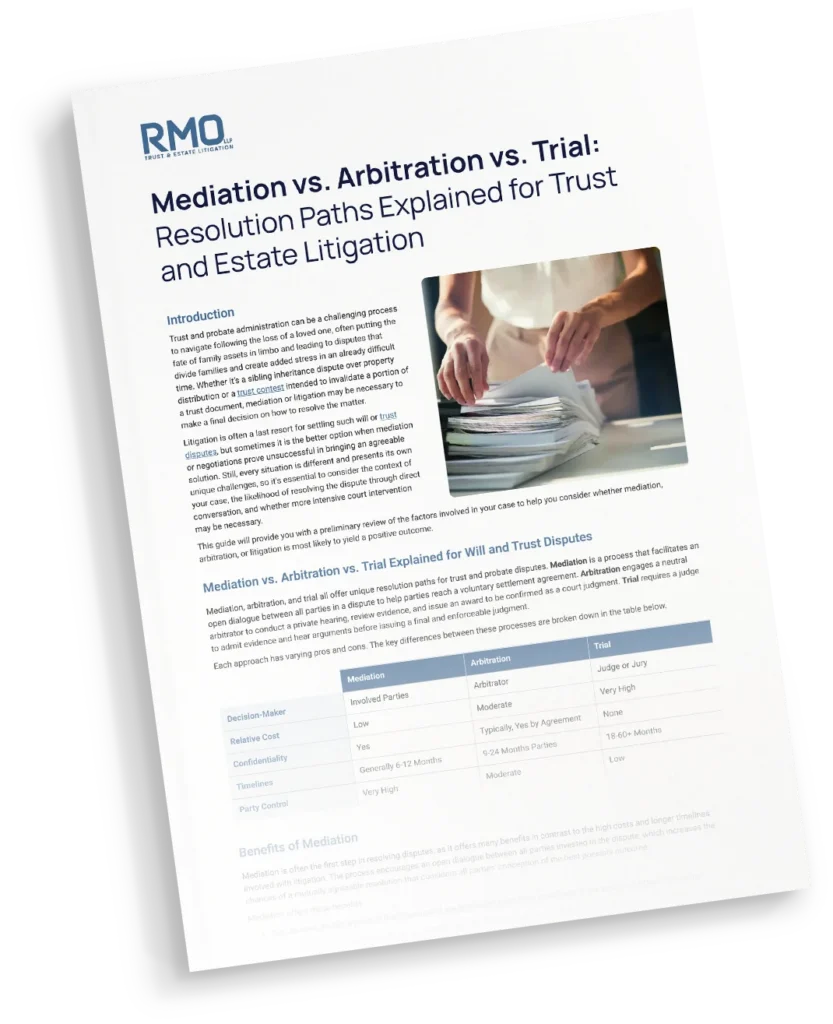
Mediation vs. Arbitration vs. Trial: Resolution Paths Explained for Trust and Estate Litigation
Download Our FREE Whitepaper to Discover Resolution Paths for Your Will or Trust Dispute
We see will and trust disputes every day. Often, interested parties in these disputes question the best way to resolve them, considering options like mediation, arbitration, and trial litigation. Every case is different, and varying family circumstances may be more conducive to one approach than another, complicating your decision on how to proceed.
Our whitepaper, which compares mediation, arbitration, and trial as resolution paths, simplifies this decision-making process by describing each method and outlining the key factors that may influence which is best for you. This resource will provide clarity into which method may be best for resolving your dispute based on the facts of your case, as well as when you should contact an attorney.

What You'll Learn From This Guide
This guide will help you understand the processes of litigation and mediation, as well as the various circumstances where litigation, mediation, and arbitration may be helpful. Our resource will give you the tools to conduct an initial assessment of the context of your case and develop a preliminary understanding of how to achieve a resolution to your family’s trust or will dispute.
You’ll learn the following:
- The definitions of mediation, litigation and arbitration
- How each method works in practice
- The key differences between the mediation, arbitration, and litigation processes
- The benefits of each approach
- How these varying methods apply to different scenarios
- Which option may be better, depending on the circumstances of your dispute
Upon reading this guide, you’ll feel more confident in addressing your family’s dispute and feel better equipped to take the next steps to seek a resolution. Altogether, this resource serves as a helpful first step in preparing to resolve a dispute before seeking guidance from an attorney.

How To Use This Guide
This guide will provide definitions and examples of various resolution paths to help you compare your situation and consider the multiple variables that may influence your case in context. You will be able to gain a deep understanding of what potential resolution paths exist so that you can assess how they may apply to your situation. Consider this guide a starting point for the decision-making process, providing insight into when methods like mediation and arbitration are preferred over trial.
This resource will allow you to understand your case in context and assess which resolution path may be preferable for the most efficient resolution. However, every case is unique, so the right approach will depend on the circumstances of your specific situation. For additional guidance, contact an experienced estate or trust litigation attorney to provide a more nuanced perspective on the best path forward.
Frequently Asked Questions
How do mediation, arbitration, and trials differ when resolving will and trust disputes?
Mediation, arbitration, and trials all provide various levels of enforceability, cost, and party control over the process. Mediation and arbitration are often considered more favorable methods of resolving disputes, as they are generally more efficient and more cost-effective.
While mediation allows for greater party control over the final outcome by facilitating an open dialogue, it does not guarantee a resolution because the parties must reach an agreement. A trial provides an enforceable judgment and resolves disputes that have gone unresolved by other methods. Arbitration stands as a middle ground between the other two processes, allowing for greater efficiency than trial but providing a more decisive judgment than mediation from a neutral third-party.
What are the main benefits of choosing mediation or arbitration over trial in a trust dispute?
Benefits of choosing mediation or arbitration over trial include the ability to achieve a quicker resolution, pay fewer court fees, experience a greater level of party participation, and remain sensitive to family relationships. Trial often takes anywhere from months to several years to litigate, which delays the ability to move forward while also generating considerable court fees. While mediation or arbitration still involves administrative costs, they are far lower compared to litigation, with a shorter timeline.
Trial also provides a decisive “winner and loser” scenario, which can be damaging to family relationships. Alternative dispute resolution methods can preserve an open dialogue that can potentially facilitate a mutually agreeable resolution that is sensitive to all parties’ interests, while also avoiding the additional stressors on family dynamics that come along with being “dragged into court” for a trial.
When is a trial necessary instead of mediation, arbitration, or negotiation in a trust or will dispute?
Trial is a necessary alternative to alternative dispute resolution methods when parties are unwilling to negotiate in these methods, when a court order is required to compel action, or when a resolution cannot be reached. Although alternative dispute resolution methods may still be an option, cases involving fraud, undue influence, embezzlement, and other matters of misconduct are most conducive to trial.
How does the mediation process help resolve estate and trust disagreements?
Mediation helps to resolve estate and trust disagreements by facilitating an open dialogue between all parties. The interested parties in the dispute will meet before a neutral, third-party mediator to discuss a voluntary settlement agreement that all sides can agree upon. This process helps alleviate tensions and encourage a resolution by giving all sides a voice in the process and dismantling the notion that there must be a clear winner and loser in the outcome, instead encouraging a compromise.
Can mediation and litigation work together in complex will or trust disputes?
Yes, mediation and litigation can work together in specific scenarios in complex disputes. Often, mediation is the first step in resolving a dispute when possible. In situations where mediation does not result in an agreement, the parties may continue to pursue a resolution through the courts.
The mediation process can also help to uncover and highlight the holes in the other party’s case, which can be beneficial in continuing your case during litigation when a settlement cannot be reached. Even after beginning the litigation process and moving into the discovery process, parties may return to mediation to continue to negotiate an agreement at any time.
How can a trust litigation attorney help with trust contests or disputes?
A trust litigation attorney can help you determine the best method for resolving your dispute based on the circumstances of your case and the unique family dynamics involved. Once you have decided how to move forward, an attorney will provide you with guidance in navigating the necessary legal processes. In litigation, an attorney will help gather evidence, establish your case, and present your case before the courts. Meanwhile, in mediation or arbitration cases, an attorney can help you build your case and assist in finding a neutral party to either mediate or decide the case.
Free Consultation
A member of the RMO Client Relations team will reach out to gather additional information concerning the parties to your case and schedule your consultation.
Communication Disclaimer
Please note that communications by you to RMO LLP or any of its lawyers through this website do not create an attorney-client relationship between you and the firm. Do not send any privileged or confidential information to the firm through this website or otherwise until instructed in writing from us to do so.