
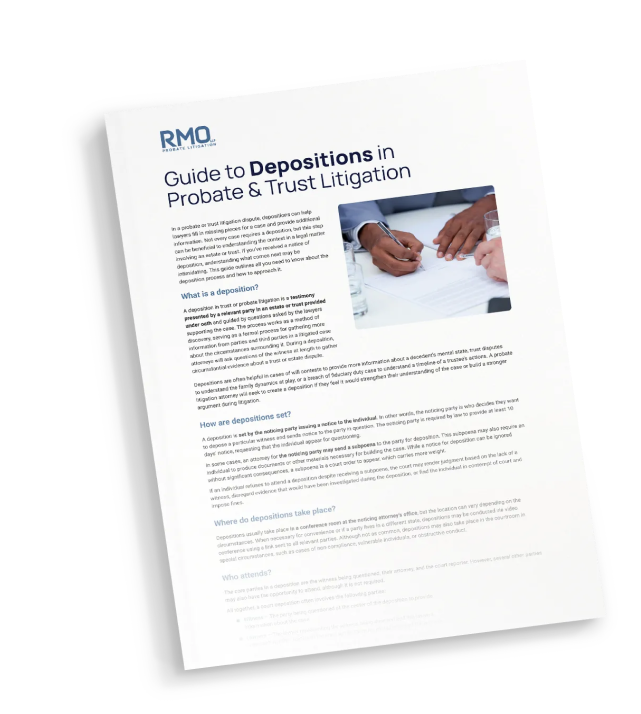
Guide to Depositions in Probate & Trust Litigation
Download Our White Paper to Understand What Depositions Are and How to Navigate Them for Probate & Trust Litigation
In trust and probate litigation, depositions are a key part of the discovery process. They allow attorneys to gather sworn testimony and important context that can shape how a case unfolds. Receiving a notice of deposition or a deposition subpoena can feel stressful, especially if you’re unsure what to expect or what will be required of you.
Our guide to probate and trust litigation depositions will help you understand what to expect and how to navigate the process.

What You'll Learn From This White Paper
This white paper provides an overview of what to expect from trust and probate litigation depositions. Depositions can be an intimidating process if you are unsure what to expect. Our deposition guide provides detailed information to give you a clear understanding of the process so you feel better prepared and more at ease.
You’ll learn the following:
- What depositions are
- How depositions are used
- What to expect from the process
- What to consider when answering questions
- How to be a successful witness in a deposition
With the above knowledge, you’ll be well-equipped to navigate a deposition as a witness. You’ll understand how the process will unfold from start to finish and have a playbook for navigating questions from the noticing lawyer.
Frequently Asked Questions
What is a deposition in probate and trust litigation?
A deposition is part of the discovery process in which a witness gives sworn testimony outside of court. Attorneys use depositions to clarify the facts of a case, understand how individuals are connected to the dispute, and gather additional context about the dispute, the people involved, the estate, or the trust at issue.
Why are depositions important in probate and trust cases?
Depositions provide sworn testimony that helps attorneys piece together the facts. They offer valuable insight into who was involved and what happened. Depending on the issues in the case, depositions can be especially important for evaluating claims of undue influence, testamentary capacity, breach of fiduciary duty, will validity, and related disputes.
Who can be deposed in a probate or trust dispute?
Both parties to the case and third parties with relevant knowledge may be deposed. Common examples include the trustee or executor, beneficiaries, family members of the decedent, the attorney who prepared the estate plan, expert professionals, like accountants, realtors, and medical professionals, and caregivers or friends of the decedent.
What kinds of questions are asked during a deposition?
Deposition questions generally focus on the facts of the case and the circumstances surrounding the dispute. Attorneys often begin with basic background questions about the witness and their relationship to the dispute, then move into more detailed inquiries.
Because discovery rules are broad, attorneys may ask questions that seem unrelated or only loosely related to the case. The purpose is to explore anything that could lead to relevant evidence. Even when a question feels off-topic, it is best to answer clearly and truthfully, while relying on your attorney to object if needed.
Do I need an attorney present during a deposition?
The law does not require you to have an attorney present at a deposition, but having one is strongly recommended. A probate litigation attorney can prepare you in advance, protect your rights during questioning, and object to improper questions on the record. This support is especially important if you are a party to the lawsuit, since your testimony can significantly affect the outcome of the case.
Free Consultation
A member of the RMO Client Relations team will reach out to gather additional information concerning the parties to your case and schedule your consultation.
Communication Disclaimer
Please note that communications by you to RMO LLP or any of its lawyers through this website do not create an attorney-client relationship between you and the firm. Do not send any privileged or confidential information to the firm through this website or otherwise until instructed in writing from us to do so.