
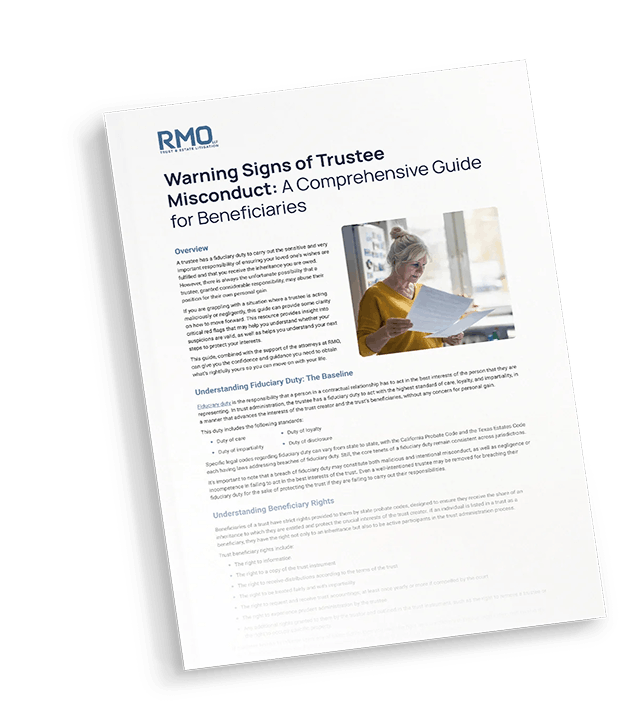
Warning Signs of Trustee Misconduct: A Comprehensive Guide for Beneficiaries
Download Our Free Guide for Identifying Warning Signs of Trustee Misconduct
Trustees are placed in a role of critical responsibility, tasked with upholding the wishes of the trust creator and ensuring beneficiaries receive the inheritance they are entitled to. Unfortunately, this responsibility can also be abused, and in some cases, trustees may end up draining trust assets rather than protecting them. It is up to beneficiaries to hold them accountable and enforce their rights, and our guide can help.
This guide will provide clarity, helping you identify crucial warning signs of trustee misconduct so you can act quickly and protect your interests in a trust and the integrity of the trust creator’s wishes. If you believe you have grounds to sue or remove a trustee based on the red flags you recognize, it’s wise to consult the attorneys at RMO for guidance.

What You'll Learn From This Guide
This guide will provide you with valuable information on how to spot critical warning signs of trustee misconduct and begin taking action before it’s too late. You will feel empowered not only to recognize signs of a trustee breach of fiduciary duty but also to take action to protect their and their loved ones’ interests.
You will learn the following:
- Exactly what trustee misconduct is and why it is harmful
- Common red flags and warning signs of trustee misconduct
- Next steps to take if you are a beneficiary
- How to proceed with additional legal guidance

How To Use This Guide
Use this guide to assess risk in cases where you suspect trustee theft or misconduct, help you identify signs of wrongdoing and determine next steps for action. If you are the beneficiary of a high-value estate and suspect trustee misconduct, you can use this guide to compare the listed red flags against your situation and the trustee behavior you are encountering.
Based on your findings from this resource and the takeaways you gather, you can feel confident in determining whether you should seek further legal advice. Then, for additional guidance, you can turn to the experienced trust litigation attorneys at RMO to help you build a case and protect your right to the inheritance you are entitled to.
Frequently Asked Questions
What is a trustee required to provide to beneficiaries?
A trustee is required to provide beneficiaries with a copy of the trust instrument, notice of the beginning of the trust administration process, and a copy of the trust accounting that details trust assets, income, and expenses, at least annually, or more frequently if required by the court or the trust document itself. A trustee is also required to provide a timely response to communications from beneficiaries.
How do I get a copy of the trust?
Beneficiaries are entitled to receive a copy of the trust from the trustee. If you have not received a copy or if you are not a named beneficiary, then you may submit a formal request to the trustee. If the trustee fails to cooperate with the request, you can petition the court to compel the trustee to act. In some cases, you may be able to see if the trust is held by another family member, held by the decedent’s financial advisor, or documented with the county recorder’s office.
What if the trustee won’t communicate?
If the trustee won’t communicate, you should begin documenting all of the communications you have sent that haven’t been responded to and should consult a trust litigation attorney for further guidance. A trustee who is failing to communicate is likely in breach of their fiduciary duty to keep beneficiaries reasonably informed. An attorney can help you navigate the court process to either compel the trustee to act or remove them, if necessary.
Can a trustee withhold distributions?
A trustee can withhold distributions only if they are granted discretion from the trust to do so. For example, if the trust states that a minor beneficiary is to have their inheritance withheld until they reach adulthood, the trustee has a right to withhold the distribution. However, if a trustee withholds a distribution in an act of self-interest or bias and without a valid reason for doing so, they would be considered in breach of their fiduciary duty, which is grounds for removal.
Can beneficiaries force a trust accounting?
Trust beneficiary rights allow beneficiaries to force a trust accounting by requesting one from the trustee. Part of a trustee’s fiduciary duty is to keep beneficiaries well-informed and provide crucial financial information related to the process. If the trustee does not provide an accounting within a reasonable timeframe, typically 60 days in California and 90 days in Texas, despite the request, beneficiaries may file a formal lawsuit with the court to obtain one.
How long does a trustee have to distribute assets in California vs. Texas?
There is no strict deadline to distribute assets in California or Texas, but they are generally expected to complete the distribution of assets in what’s considered a “reasonable timeframe”. How long a trustee has to distribute assets varies according to the trust’s complexity, but a reasonable timeline is often considered to range from about 6 to 18 months.
Can I sue a trustee for emotional distress caused by their misconduct?
Yes, depending on your circumstances, you may be able to sue a trustee for emotional distress caused by trustee misconduct, but it is often difficult and requires proving that the misconduct was extensive and intentional or negligent. Proving emotional distress may require extensive evidence, depending on the case, which may include aspects like medical records from a therapist or testimony of severe symptoms. However, before granting damages for emotional distress, the court will likely take steps such as removing the trustee or compelling specific actions first.
What is the statute of limitations for suing a trustee for breach of fiduciary duty?
While it depends on a state-by-state basis, the statute of limitations for suing a trustee for breach of fiduciary duty is generally between 1 and 4 years. In California, depending on the facts involved, such matters are typically addressed under the California Code of Civil Procedure section 343, which establishes a four-year statute of limitations for lawsuits. However, if the act of trustee misconduct involved fraud or deceit, then the timeline maybe shortened to three years according to California Code of Civil Procedure section 338(d).
Meanwhile, in Texas, the statute of limitations for suing a trustee for breach of fiduciary duty is generally four years, according to the Texas Civil Practice and Remedies Code 16.004, beginning at the point when the beneficiary discovers or should have discovered the trustee’s misconduct.
Does a trustee have the right to use trust money to defend themselves in court?
Yes, a trustee typically has the right to use trust money to defend themselves and the trust in court against frivolous lawsuits. However, if a trustee is found liable by the court for wrongdoing, they will generally have to return these funds to the trust.
What happens if the trustee has already spent all the money?
If a trustee has already spent all of a trust’s money due to their misconduct, they may be held personally liable for losses to the trust by the court in a lawsuit and ordered to pay a surcharge. Beneficiaries will have to raise the matter in court to seek compensation for the losses. The risk of a trustee spending all the trust’s money means it is crucial that interested parties act quickly to preserve these assets at any point that they believe a trustee is acting with misconduct.
Can a beneficiary remove a trustee without going to court?
Yes, a beneficiary can remove a trustee without court intervention if they are granted authority to do so by the trust document or if they are able to negotiate an agreement with the trustee to resign. However, a beneficiary still retains the option to remove a trustee by petitioning the court if they have sufficient evidence to do so, even if they are not granted authority by the trust instrument.
Is it misconduct if the trustee pays themselves a salary?
No, it is not misconduct if the trustee pays themselves a salary, so long as the finances are considered reasonable and permissible by the trust document or state law. Compensation is considered to be reasonable if it is proportionate to the complexity of the trust and the level of work performed and it is not disallowed by the trust document.
However, if the trustee is paying themselves more than is allowed by the trust or is failing to disclose the amount they are paying themselves, then this begins to constitute misconduct, and interested parties should consult an attorney as soon as possible.
Free Consultation
A member of the RMO Client Relations team will reach out to gather additional information concerning the parties to your case and schedule your consultation.
Communication Disclaimer
Please note that communications by you to RMO LLP or any of its lawyers through this website do not create an attorney-client relationship between you and the firm. Do not send any privileged or confidential information to the firm through this website or otherwise until instructed in writing from us to do so.