U.S.C. § 1782 Discovery in Foreign Dissolution Proceedings
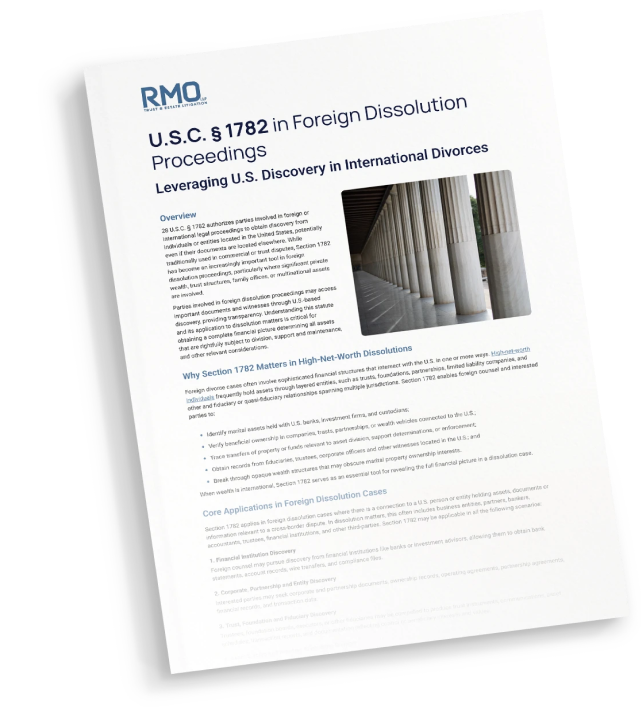
Download the Guide for Leveraging U.S.C. § 1782 in Foreign Dissolution Proceedings
Foreign dissolution proceedings, like a divorce, legal separation, or business dissolution, ever-increasingly involve the discovery of international assets. For documentation or witnesses located in or reachable through United States based individuals or entities, 28 U.S.C. 1782 provides a robust legal mechanism that can be used to discover assets, creating leverage to resolve international disputes or better prepare them for trial.
Counsel handling a foreign dissolution action involving assets located in or connected to individuals, trusts, financial institutions or other entities subject to U.S. jurisdiction should be well-versed in how to utilize or defend against these processes to ensure their clients’ respective interests are protected.
If you’re involved in divorce or dissolution proceedings with international assets, this playbook can help you understand when and how you may seek international asset discovery through Section 1782. This detailed guide, combined with the guidance of experienced local counsel, like the attorneys at RMO, can help you to navigate these processes with confidence.

What You'll Learn From This Guide
This guide provides key information parties need to be aware of to initiate or defend against U.S. discovery in international divorce and foreign dissolution proceedings. The guide is beneficial to any interested individual, and their foreign counsel, involved in cross-border litigation, allowing them to understand the key legal principles behind Section 1782, why it is helpful, and how to use it.
You can expect to learn the following:
- What exactly U.S.C. § 1782 is
- Why this statute is important for international divorces and other foreign dissolution proceedings
- How Section 1782 is commonly used in high-net-worth dissolution matters involving divorces, corporate dissolutions, trusts, private wealth, and cross-border assets
- Core applications of the statute in foreign dissolution proceedings
- What to expect from engaging in this process
- Steps to follow to identify key assets
- The value of getting support in navigating this process from a skilled attorney

How To Use This Guide
Foreign counsel and interested parties in cross-border foreign dissolution proceedings can use this guide to better understand how to access the U.S. discovery process for international proceedings. This playbook will provide valuable guidance on what the statute is, how it may apply to your case, and the necessary steps for using this powerful litigation strategy.
This guide will help you understand the foundational principles of Section 1782 and when it can be used to benefit your case. If you are navigating an international dissolution proceeding, such as divorce or business dissolution, get additional, personalized guidance from the experienced attorneys at RMO.
Frequently Asked Questions
What exactly is Section 1782?
U.S.C. 1782 is a federal statute that grants parties or interested persons in a foreign legal proceeding the ability to seek U.S. discovery to obtain relevant evidence, including documentary evidence and testimony, from third-parties located in or reachable from the United States. This statute allows parties in international disputes to request U.S. court assistance in issuing subpoenas to third-parties for relevant documents and information, even when the country of origin lacks similarly- robust discovery processes.
The statute applies equally to international divorce and dissolution proceedings as well as criminal cases, commercial litigation, estate proceedings, and more. Relevant evidence that parties can gather through U.S.C Section 1782 may include corporate records, bank statements and other financial records, and witness testimony.
Can Section 1782 be used to find assets in an international divorce?
Yes, U.S.C. § 1782 can be used to locate assets such as bank or investment accounts, real estate, business interests, trust assets, and other financial holdings in an international divorce or dissolution proceeding. The statute grants access to discovery through United States courts, which is particularly useful when foreign legal systems provide limited or no discovery mechanisms.
This process allows foreign counsel and interested parties to obtain a more complete understanding of an individual’s assets. If there are documents or witness testimony relevant to the dissolution proceeding, Section 1782 can help bring that information to light.
What happens if a trust is "offshore" but has a U.S. trustee?
If a trust is “offshore” but has a U.S. trustee, this may create jurisdictional and discovery implications under U.S. law, including potential access to trust-related documents that the U.S. trustee has possession, custody or control of through U.S.C. § 1782. U.S. courts will evaluate factors such as trustee location, the level of access, control and influence the trustee has over the information sought, etc. when assessing discovery requests.
Tax treatment and classification issues may also arise depending on the structure of the trust and the residency of beneficiaries, and these issues should be evaluated with appropriate legal and separate tax advisors.
What specific evidence can one obtain through Section 1782?
In a foreign proceeding, parties can use U.S.C. § 1782 to obtain testimonial evidence, such as depositions and witness testimony, and documentary evidence, including financial records, communications, corporate records, and estate planning documents. In dissolution proceedings, this may include bank statements, real estate records, corporate records, and records held by fiduciaries, trustees, or financial institutions located in the United States, even if the records are located outside of the United States.
Can a RMO help me with international divorces and U.S.C. § 1782?
Yes. When a foreign dissolution proceeding involves U.S.-based assets or witnesses, attorneys like those at RMO can assist foreign counsel or interested parties in evaluating discovery options and pursuing appropriate relief under U.S.C. § 1782. Discovery can be a critical tool for obtaining evidence related to assets connected to or through the United States. An attorney experienced in navigating international discovery under Section 1782 will be able to advise you concisely and better than a local family law attorney or general commercial litigator might.
Free Consultation
A member of the RMO Client Relations team will reach out to gather additional information concerning the parties to your case and schedule your consultation.
Communication Disclaimer
Please note that communications by you to RMO LLP or any of its lawyers through this website do not create an attorney-client relationship between you and the firm. Do not send any privileged or confidential information to the firm through this website or otherwise until instructed in writing from us to do so.