
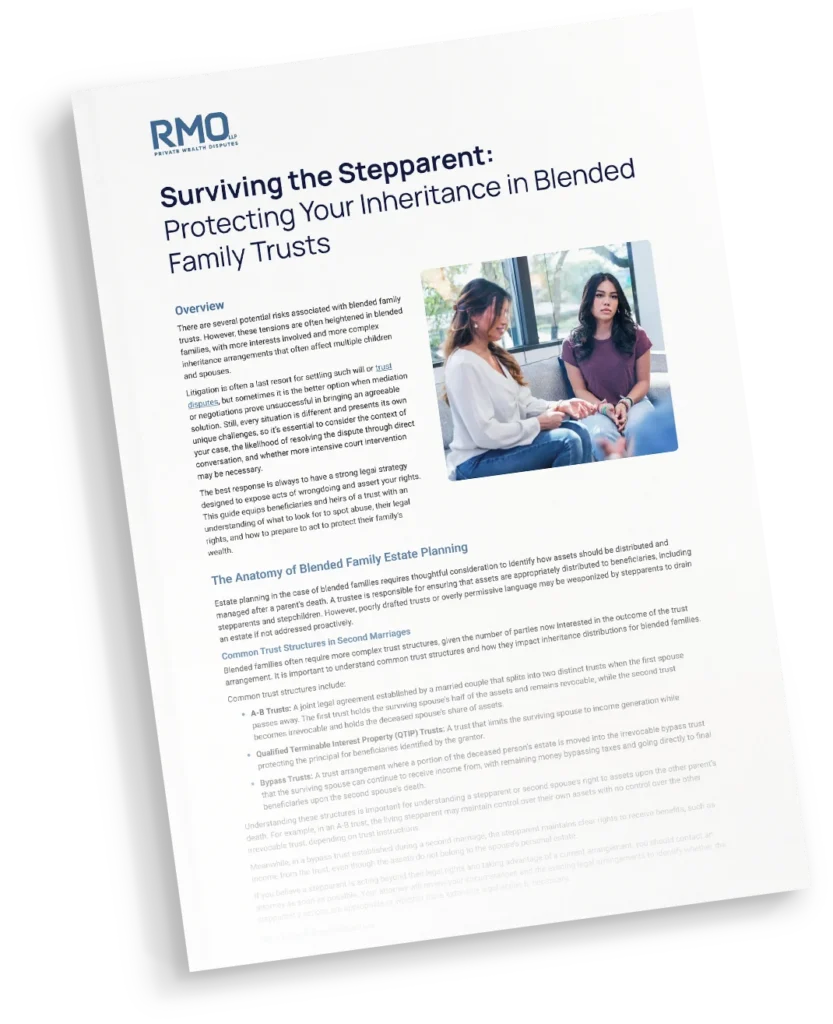
Surviving the Stepparent: Protecting Your Inheritance in Blended Family Trusts
Download Our Free Guide to Discover Actionable Strategies for Protecting Your Inheritance from an Overreaching Stepparent
Trust administration is already a particularly difficult process, with many serious emotions after the loss of a loved one and the many conflicting interests involved in the distribution of assets. However, in blended families that involve a stepparent, these scenarios become even more complex with additional stakeholders, additional inheritance claims, and occasionally multiple estate plans.
When a stepparent acts maliciously and attempts to exploit a trust, it can create even more substantial problems. Such matters require a detailed understanding of the potential risks of a stepparent acting with ill intent and how to respond with a strong legal strategy. Our guide provides an opportunity to understand the potential complexities that arise, insight into when to consult a trust litigation lawyer, and guidance on navigating these complexities with confidence.

What You'll Learn From This Guide
This guide is designed to provide you with an easy-to-follow explainer for the potential concerns you may face in blended family trust disputes or stepparent trust litigation, including when an individual takes advantage of a family trust at the expense of other interested parties and beneficiaries. In this guide, you’ll learn:
- The mechanics of blended family trusts, including how they are structured and how stepparents may exploit them
- How to spot the red flags of abuse, such as signs of undue influence, self-dealing, and fiduciary misconduct
- Your indisputable rights as a beneficiary in California and Texas and how to exercise them to protect your inheritance from a stepparent
- When and how to contest a trust and how to navigate the complexities of a stepparent trustee acting with misconduct
- Strategic defensive legal actions that involve forcing forensic accountings, suspending a rogue stepparent, or recovering stolen assets.

How To Use This Guide
Use this guide to understand where you stand as a beneficiary, begin strengthening your legal case, and assess the immediate risk to your rights and your family’s wealth by comparing your stepparent’s behavior to the red flags listed in our guide. Learn more about common trust vulnerabilities to help you audit your family’s trust and then identify critical evidence to begin gathering to substantiate your case.
Once you have a firm understanding of the factors in cases involving family blended trusts, this guide will help you prepare for a legal consultation with a clear view of the trust administration and litigation processes. Begin developing an action plan and a fierce legal strategy by consulting an attorney and using the insights provided in this guide.
Frequently Asked Questions
Can a stepparent change an irrevocable trust after my parent dies?
No, a stepparent cannot change an irrevocable trust after your parent dies. An irrevocable trust should not be changed or altered in any capacity once your parent dies.
If you suspect that your stepparent attempted to change an irrevocable trust after your parent’s death, then they may be liable for fraud or forgery and you should consult an attorney as soon as possible for support.
What happens if my stepparent spends all the money in a QTIP trust?
If your stepparent spends all the money in a QTIP trust and does not have the authority to do so as a trustee, they may be required to repay this money. They may be subject to a surcharge order that compels them to refund the trust either through direct payment, a lien on property, or other mechanisms.
How do I prove my stepparent unduly influenced my parent's estate plan?
Proving undue influence is a complex legal process that typically requires multiple forms of both direct and circumstantial evidence. In determining whether an estate plan was the product of undue influence, the following four factors are considered:
- Vulnerability of the victim
- Authority of the influencer
- Manipulative or coercive tactics
- An unfair or inequitable outcome
To establish these four factors, options for proving undue influence may include medical records demonstrating vulnerability and a lack of mental capacity, evidence of forgery of estate-planning documents, communication records evidencing coercion or pressure, or witness testimony recounting wrongful persuasion.
Does a no-contest clause prevent me from suing my stepparent for fiduciary abuse?
No, a no-contest clause does not prevent you from suing a stepparent for fiduciary abuse. A no-contest clause typically applies to the content of a trust and is designed to protect against frivolous legal challenges. In contrast, fiduciary abuse typically does not challenge the trust itself, but rather how the trustee is managing the trust. If you are experiencing stepparent fiduciary duty abuse, you have the right to contest the trustee’s actions. Ultimately, it is best to speak with a trust litigator to determine whether your specific claim could trigger a no-contest clause.
How long do I have to contest a trust in California and Texas?
In California, you generally have 120 days from the date that Statutory Notification 16061.7 is sent out by the trustee to beneficiaries to contest the trust, or 60 days from the date you receive a copy of the estate plan within that 120-day period, whichever is longer, according to California Probate Code Section 16061.7.
Meanwhile, in Texas, beneficiaries may have as long as four years to contest a trust starting from the date on which they should have reasonably known about the grounds to challenge the trust, according to Texas Civil Practice & Remedies Code Section 16.004, which governs limitations for cases involving fraud and breach of fiduciary duty.
Keep in mind that every case is different, and several factors may affect your deadline to contest a trust, so you should consult an attorney as soon as possible.
Can a stepparent legally sell a house that is in a trust?
Whether a stepparent may legally sell a house depends on the rights that they are granted by the trust and their own legal rights to the property itself. If the house belongs solely to the trust, the stepparent has no claim to the property and is not allowed by the terms of the trust to sell the property, then they may not sell the house.
However, if they have a claim to the property or the terms of the trust permit it, they may be allowed to sell the house. To determine whether a stepparent may sell a house in your matter, it is best to consult with a trust attorney, providing them with a copy of the trust and any relevant deeds so that they may determine rights to the property and rights under the trust itself.
Who pays for the lawyer if I sue my stepparent for stealing from the trust?
If you sue a stepparent for stealing from a trust, you must pay for the lawyer, as each party is generally responsible for paying their own legal fees, although a trustee may use trust funds to defend the interests of the trust.
However, if a trustee or other interested party, such as the stepparent, is found to have engaged in misconduct such as asset mismanagement or theft, the court may order the offending party to reimburse the trust for any losses and repay legal fees to the party who brought the lawsuit as part of their restitution.
Free Consultation
A member of the RMO Client Relations team will reach out to gather additional information concerning the parties to your case and schedule your consultation.
Communication Disclaimer
Please note that communications by you to RMO LLP or any of its lawyers through this website do not create an attorney-client relationship between you and the firm. Do not send any privileged or confidential information to the firm through this website or otherwise until instructed in writing from us to do so.